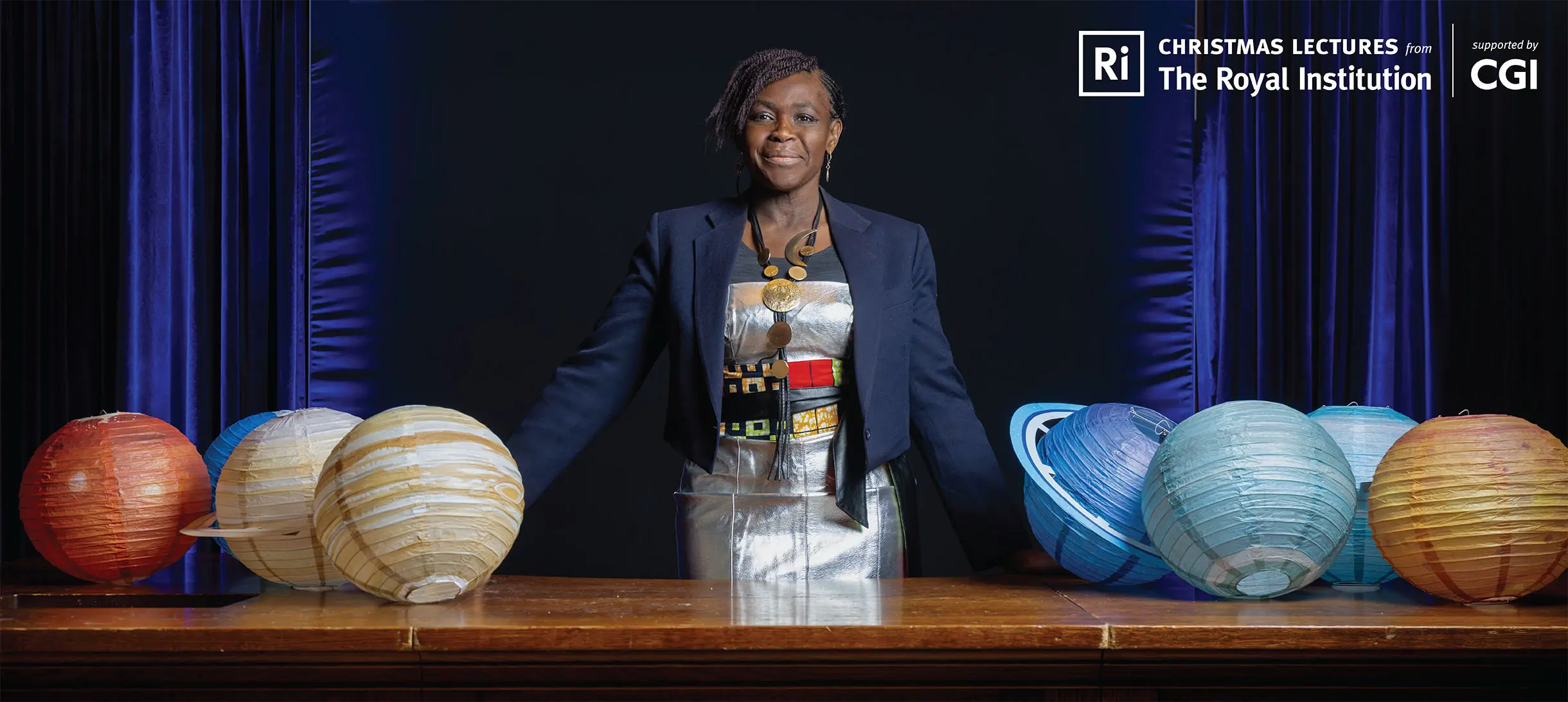
The 2025 CHRISTMAS LECTURES from the Royal Institution, supported by CGI, will see leading space scientist Dame Dr Maggie Aderin take audiences on an epic voyage through time and space on this 200th anniversary of the CHRISTMAS LECTURES.
Joined by a host of very special guests - from astronauts to history-making astronomers - Maggie explores the extraordinary breakthroughs that have revolutionised our understanding of the universe, enabling us to see ever further into space, and ever further back in time.
Lecture 1 - Destination Moon
Dame Dr Maggie Aderin-Pocock begins her search for extraterrestrial life with an exploration of our nearest neighbour, and her favourite space rock, the moon.
Scientists in 2025 detected the 'strongest hint yet' of biological activity outside our solar system on exoplanet K2-18b, sparking growing excitement about the real possibility of extraterrestrial life. In this series of lectures, Dame Dr Maggie Aderin-Pocock sets out on a journey to find it.
In lecture 1, self-confessed ‘lunartic’ Maggie explores the history of our own species in space, joined by the UK’s latest crew of European Space Agency astronauts - Rosemary Coogan, John McFall and Meganne Cristian. From the early Apollo missions to the planned Artemis Moon landing in 2027, the astronauts join children from the audience in a series of demos that illustrate the challenges of human space travel and the reality of colonies on the moon and beyond. Maggie uses this lunar viewpoint to look back on our own planet and ask some fundamental questions about life.
Watch the lecture below:
Lecture 2 - Searching the Solar System
Space scientist Dame Dr Maggie Aderin-Pocock continues her search for alien life with a grand tour of our solar system. Could any other planets or moons be habitable?
Maggie traces the evolution of our understanding of the solar system, from the ancient Greeks’ observations of the ‘wandering stars’ to the latest discoveries from modern space missions.
Beginning with the Sun, she explores how its energy and materials make life possible — and why we are all made of stardust. She then visits Mercury and Venus, including the possibility of life in Venus’s thick atmosphere, before travelling to Mars. On Mars, Maggie examines evidence from recent rover missions suggesting the planet once had abundant water and conditions suitable for microbial life. She also introduces the UK-built Rosalind Franklin Mars Rover, which is due to launch in 2028 and will search beneath the Martian surface for evidence of ancient life.
The journey continues to Jupiter and Saturn, where Maggie explores some of their hundreds of moons. Could Europa’s hidden ocean or Titan’s methane lakes provide the conditions for life? She also looks at the Europa Clipper mission, which is travelling to Jupiter to investigate Europa’s habitability. Finally, Maggie travels beyond Uranus, Neptune and Pluto before catching up with the Voyager probes, which have spent almost 50 years travelling towards interstellar space. Hear the extraordinary sounds of Voyager 1 crossing the heliosphere — the vast bubble created by our Sun.
Watch the lecture below:
Lecture 3. To the Stars and Beyond
In her final lecture, Maggie takes her audience beyond our solar system, deep into the Milky Way galaxy, and yet further out into the universe, where the chances of finding life out there, somewhere, seem greater than ever before.
On Christmas Day 2021, the most powerful space telescope ever created, the James Webb Space Telescope, was launched. Maggie played her own part, helping to build one of the key instruments on board, and now the JWST is sending back the most extraordinary images and is one of our key tools in the hunt for alien life. With the help of British astronaut Tim Peake, Maggie and the audience grasp the scale of JWST’s huge mirror and demonstrate the challenges of launching it into space. Tim recalls his own experiences of travelling into space ten years ago and reveals the impact on his perspective about what might be out there beyond Earth.
As Maggie and Tim examine just how common extraterrestrial life might be, she unpacks Frank Drake’s 1961 equation, designed to calculate how many detectable extraterrestrial societies exist in our galaxy. How do the numbers change now that we know exoplanets are so common and that our galaxy has so many more stars than we thought? And then what about galaxies beyond our own? Where we once thought there were around 100 billion galaxies in our universe, Hubble's 'deep field' images have revealed at least two trillion!
Will we ever find definitive evidence of extraterrestrial life? Or even experience our own alien encounter? If we did detect an alien civilisation, what do we think it might look like, and what would we say to it?
These are some of the many questions future scientists and astronomers will be grappling with, and we invite our audience of young people to contribute to that discussion. It’s up to future generations to take up the baton – to infinity and beyond.
Watch the lecture below: