The Einstein Telescope, currently planned for operation in 2035, will be one of the most powerful tools for detecting gravitational waves and testing the theory of General Relativity. Not only is it a wonder of scientific design, but it's also a platform for international cooperation and innovation.
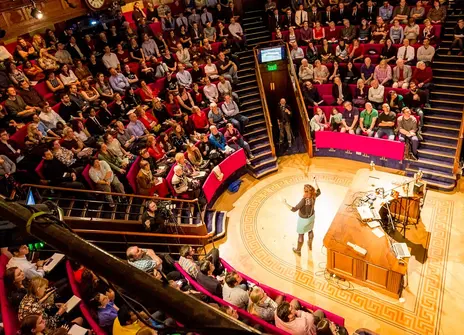
In this talk, theoretical physicist Robbert Dijkgraaf will delve into the details of what makes the Einstein Telescope so special. What does it do, what are we hoping to learn, and how can scientific collaboration between countries be a valuable source of soft power?
Once constructed, the telescope is expected to provide scientists with some of the most sensitive equipment ever for answering some of these fundamental questions. As well as testing Einstein's general theory of relativity, it will be able to search for dark matter, help unlock the secrets of the early universe, and teach us more about black holes and neutron stars.
This talk is presented in collaboration with the Embassy of the Netherlands.
Event type
This is a theatre and livestream event for an adult audience, where the speakers and audience in our Theatre are joined by our audience online.
By booking to attend events at the Royal Institution, you confirm that you have read and accept the Ri's event terms and conditions. You also agree to abide by our code of conduct, and help to create a great experience for yourself and your fellow participants. Please note that Eventbrite adds a small booking fee to the amount paid for each ticket option.
For any queries regarding this event please get in touch by phone 020 7409 2992 or email events@ri.ac.uk.
This is an event at the Ri.
About Robbert Dijkgraaf

Robbert Dijkgraaf is a mathematical physicist, currently Distinguished University Professor at the University of Amsterdam, where his research focuses on the interface between theoretical physics and mathematics.
He previously led the Institute for Advanced Study in Princeton, and his work involves the understanding of string theory, black holes and topological field theories.
As President-elect of the International Science Council, and a former Minister of Education, Culture and Science in the Netherlands, he has made significant contributions to international science policy.
He received the Spinoza Prize, the highest scientific award in the Netherlands, is a Knight of the Order of the Netherlands Lion, and is a fellow of the Royal Society.
Event timing
This event will start at 7.00pm. Doors to the theatre will open approximately 15 minutes before the start time.
The building will open from 6.00pm.
Please allow plenty of time to take your seat. We reserve the right to refuse admission to latecomers.
Accessibility
The event will take place on the first floor and there is step-free access from the street via lift.
The closest underground station is Green Park, which is step-free.
There is space at floor level in the theatre for wheelchair users.
Seating is usually unreserved for our events. If you and your group require seating reservations, please do let us know by emailing us at events@ri.ac.uk, and we’ll be more than happy to help.
Carers can receive a free ticket to an event by emailing events@ri.ac.uk.
Our theatre is equipped with an Audio Induction Loop.
Event terms and conditions
Eventbrite
Online booking for Royal Institution events is run by a third-party service, Eventbrite (www.eventbrite.co.uk).
To book Royal Institution events through Eventbrite users must register with Eventbrite and set-up user account with a unique email and password. All information provided by you or collected by Eventbrite in connection with the Services is governed by Eventbrite's Privacy Policy, a copy of which is located at www.eventbrite.com/privacypolicy. The Royal Institution reserves the right to send you emails relating to the specific event(s) you have booked. Please note that Eventbrite adds a small booking fee to the amount paid for each ticket option.
View the full Eventbrite terms of service (www.eventbrite.com/tos)
Errors
Errors made by you when entering your data, are your responsibility and the Royal Institution will not be held responsible for any inconvenience caused by the supply of incorrect personal information, nor will we offer refunds on any accidental purchases made. It is your responsibility to check that the tickets issued to you are accurate.
Event partners
The Royal Institution occasionally runs events in partnership with other organisations, learned societies and charities. In this instance we reserve the right to share your contact details with these third parties, solely for the purpose of providing you with information relating to that event.
Refunds and exchanging tickets
The Royal Institution will only guarantee a refund if the event is cancelled by us. Our liability in this case will be limited to the face value of your tickets.
Free tickets may be released at any time by the user at no charge.
Science Short Courses
For Science Short Courses, attendees may request a refund up to 7 days before the start of the course. After this point, a refund cannot be offered.
Member tickets
You must ensure that you book only the tickets for which you are eligible based on your level of membership at the time of the event. The Royal Institution reserves the right to cancel your ticket if member ticket eligibility criteria are not met.
Concessions
Concession tickets are available for the following groups:
- Aged 66 or over
- Aged 16 or under
- Full-time students
- Unwaged
- Anyone in receipt of Universal Credit
- Disabled
All children aged 4 and above need a ticket to attend events at the Ri.
Payment
For online payments processed through Eventbrite payments may be made using American Express, MasterCard, Visa, or Visa Debit.
Payments made by phone are processed by a secure Tier 1 DSS compliant payment processor. We accept MasterCard, Visa, Visa Delta, Maestro and American Express. We cannot accept Solo, Visa Electron or Diners cards.
Bookings on behalf of a party of people
If you are booking on behalf of a party, you accept these terms and conditions on behalf of all members of your party and are responsible for all payments due from the party.
Age suitability
Unless specified, our public events are suitable for ages 15 and above. However for most events, younger children are more than welcome to attend with parental permission.
Children aged under 13 years must be with accompanying adult. If you are unsure of the suitability of an event for a young person, please contact the Public Programme team at events@ri.ac.uk.
Freedom of speech
The Royal Institution is a forum for the free and open discussion of ideas, and we recognise the fundamental importance of freedom of speech within the law. All speakers who contribute to any of our programmes represent their own views and do not necessarily represent the views of the Royal Institution.
Before the event
To gain access to our online events, you will need to book a ticket through our Website. The ‘Book Tickets’ button will take you to the Eventbrite page for the same event. Our prices range from £3 for Ri Members or Ri Patrons, to £20.
If you are a Ri Member or Ri Patron, and want to choose a higher priced ticket, you are free to do so.
Once you have purchased your ticket, you will get an email confirmation from Eventbrite.
There will be two reminder emails sent out. One 2 hours before the event takes place and one 10 minutes before the event takes place. These will have an option to log in through Eventbrite to watch the event, or use the direct webpage link.
During the event
We aim to go live 5 minutes before the event begins.
If you have a blank screen or no sound, please refresh the page. Sometimes for the sound, you will need to actively unmute the video by pressing the volume icon on the video itself.
If you’re still having issues at the start time of the event, you can either:
-
Contact us through the chat box on the webpage
-
Email us through Eventbrite
-
Email us directly through events@ri.ac.uk
There are some occasions where technology works against us, and we will have to postpone the event. We will notify you:
-
Via the chat box. The host will keep you updated between 5 mins before the start and the cut off time of 15 minutes after the start.
-
Via email. This may be slightly more delayed response but the host will answer you there.
-
Finally, via Eventbrite email. This will go to all audience members and will be sent if the event is being postponed.
After the event
Ticket holders will be able to rewatch the recording of the event for two weeks after the event takes place. A reminder of this will be sent out via Eventbrite email the day after the event.
We try to upload our events to our YouTube channel within a couple months’ time. Here, it is free for everyone to view.
Find out more
Read all our livestream FAQs here.
Refunds and exchanging tickets
The Royal Institution will only guarantee a refund if the event is cancelled by us. Our liability in this case will be limited to the face value of your tickets. If you have purchased tickets by phone and wish to cancel your booking, please phone 020 7409 2992 or email events@ri.ac.uk. If you have purchased tickets via Eventbrite and wish to cancel your booking you will need to log into your personal Eventbrite account. You may only request a refund if you have cancelled your ticket at least two weeks (14 days) prior to the workshop start date. After this date, a refund may be possible, but only if there is someone on the waiting list who can take your place.
Age restrictions
Holiday workshops are very strictly for students within the year groups advertised for each event. We are unable to accept bookings for students outside these year groups and any bookings made for students who are not in the correct year group at the time of the workshop may be cancelled. This is to make sure all students attending can get the most out of their experience.
Other information
Workshops which run from 11am to 3pm include a lunch break and students must bring a packed lunch and a drink. As long as permission is given during the booking process students aged 15–18 can leave the building during this lunch break.
For ages 12–18 students can leave workshops unattended, as long as permission is given during booking. For ages 7–11, students will be fully supervised and only allowed to leave the building when collected by their responsible adult.
If students have any allergies, medical conditions or access requirements please inform us of these at the time of booking, so we have time to make any adjustments required. If you have any questions or concerns please contact us via events@ri.ac.uk.
Safeguarding
The Royal Institution (Ri) is committed to safeguarding children and adults at risk and promoting their wellbeing. We strive to ensure a safe environment for everyone participating in Ri activities, including Ri workshops.Visit our Safeguarding pages on our website for further details including information on how to report a concern: https://www.rigb.org/about-us/safeguarding
Event changes
The Royal Institution reserves the right to make any alterations to speakers, event content, event timing and/or event venue, and will make reasonable efforts to contact audience members to inform them of any changes. The Royal Institution will not be held liable for any changes made to the advertised event.
Right to refuse and search
The Royal Institution reserves the right to refuse you admission if, in its reasonable opinion, your admission to the venue might:
- Be a risk to the safety of the audience and/or yourself, and/or
- Affect the enjoyment of members of the audience, and/or
- Affect the running of the event
For example, if you act aggressively and/or appear to be under the influence of drink and/or drugs, you will be refused admission. We may also request you to leave (taking any such appropriate action that may be necessary to enforce this right) before or during events for any of the reasons given above. Should you be refused admission or requested to leave you will not be entitled to a refund. The Royal Institution may also, on certain occasions, have to conduct security searches to ensure your safety.
Children
All children under the age of 13 must be accompanied by an adult while in the theatre. The Royal Institution reserves the right to refuse admission to an unaccompanied child under the age of 13.
All children aged 4 and above need a ticket to attend events at the Ri.
Latecomers
The Royal Institution will, in most cases, be able to seat you if you arrive late to an event. However, we reserve the right to refuse you admission if you do not arrive by the start of the event. We also reserve the right to re-sell your ticket if you have not arrived by the start of the event. In the event of this occurring, we will endeavour to find you a seat or standing room, but this cannot be guaranteed.
Risk assessments
For a copy of the risk assessment prepared for schools attending Royal Institution events, please email schools@ri.ac.uk
Filming and recording
By attending a Royal Institution event, audience members consent to being filmed, livestreamed, recorded and photographed. Audience members grant the Royal Institution the right to use recordings of any type made of their attendance in any and all media, and by means of publicity and promotion relating to the Royal Institution. School parties should ensure that appropriate parental permission is obtained before attendance at any Royal Institution event.
The unauthorised use of photographic, sound or film equipment in the venue is strictly prohibited. If you wish to use this equipment, please contact the Events Team prior to the start of the event. The copyright is assigned to the Ri for any recordings of events produced by the Ri. Unauthorised recording may result in content being destroyed, and your removal from the event without a ticket refund.
Electronic equipment
All electronic equipment, especially mobile phones, must be set to silent before entering the Theatre and/or any other spaces where events are taking place.
Smoking
The Royal Institution operates a non-smoking policy throughout its entire building.
Some special events, for example the CHRISTMAS LECTURES, have Terms and Conditions for booking and attendance that supersede the ones given here. In those cases we will inform you of the new Terms and Conditions on booking.