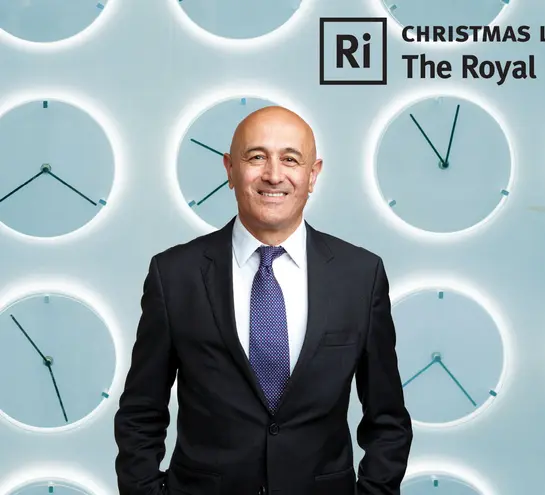
Professor Jim Al-Khalili is a multiple award-winning science communicator renowned for his public engagement around the world through writing and broadcasting, and a leading academic making fundamental contributions to theoretical physics, particularly in nuclear reaction theory, quantum effects in biology, open quantum systems and the foundations of quantum mechanics.
Jim is a theoretical physicist and a Distinguished Emeritus Professor of Physics at the University of Surrey. He received his PhD in nuclear reaction theory in 1989 and has published widely in the field. His current research interests are the foundations of quantum mechanics, the arrow of time, open quantum systems, and the application of quantum mechanics in biology.
He is a prominent author and broadcaster. He has written 15 books on popular science and the history of science, many translated into twenty-six languages. His latest book is ‘On Time: The Physics that Makes the Universe Tick’, published by Princeton Press in September 2026. Other books include ‘Pathfinders: The Golden Age of Arabic Science’ (2010), shortlisted for the Warwick Prize; ‘Life on the Edge: The Coming of Age of Quantum Biology’ (2014); and ‘The World According to Physics’ (2022), both shortlisted for the Royal Society Book Prize. He is a regular presenter of TV documentaries, including the Bafta-nominated ‘Chemistry: a volatile history’, and hosts BBC Radio 4’s ‘The Life Scientific’.
Jim is a past president of the British Science Association and a recipient of the Royal Society Michael Faraday Medal and the Wilkins-Bernal-Medawar Medal, the Institute of Physics Kelvin Medal and the Stephen Hawking Medal for Science Communication. He received an OBE in 2007 and a CBE in 2021 for services to science. He is a patron and vice president of Humanists UK, a patron of the Orthopaedic Research Society, the National Education Museum, the UK Metric Association, RASHID International and the Daphne Jackson Trust.
He is a Fellow of the Science Museum Group and a Commissioner for the Royal Commission of 1851.