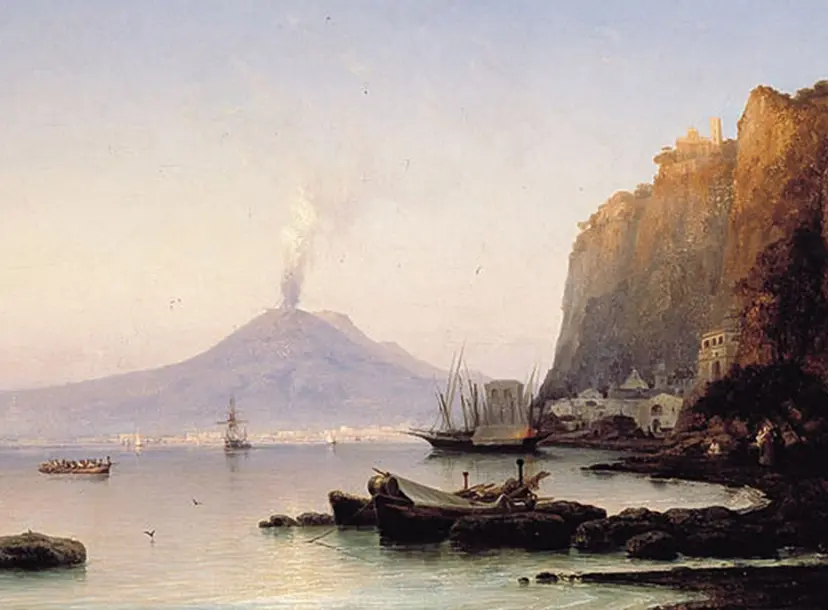
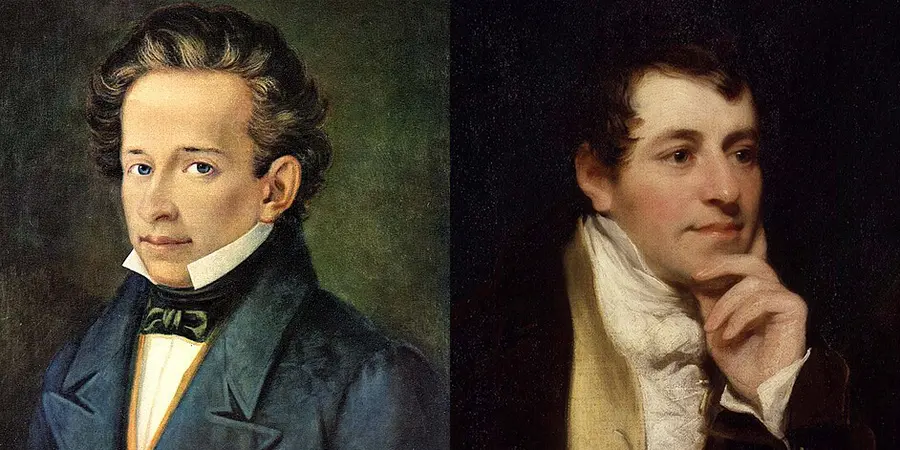
At first glance, Humphry Davy and Giacomo Leopardi seem to belong to entirely different worlds. Davy (1778-1829) was one of Britain’s most celebrated chemists, famous for his experiments with electricity and for isolating new chemical elements. In 1802, he was appointed professor of chemistry at the Royal Institution, where, during the first decade of the nineteenth century, he also delivered several lectures on geology and volcanoes. Leopardi (1798-1837), by contrast, was a poet and philosopher, one of the most radical literary voices of the Romantic Age. Yet, in the final years of their lives, both found themselves drawn to the same landscape: Mount Vesuvius and the ruins scattered around the Bay of Naples.
For Davy, the volcano appeared in the second dialogue of Consolations in Travel, or the Last Days of a Philosopher (1830), a philosophical work composed after illness forced him away from scientific research, published posthumously by his brother. For Leopardi, Vesuvius provided the setting for La ginestra (‘The Broom’, 1836), the poem often considered his final poetic testament, written while living near Naples shortly before his death.
What is remarkable is that both writers arrived at strikingly similar reflections through apparently different intellectual paths. In both works, volcanoes and ruins become more than picturesque scenery: they become instruments for thinking about deep time, the rise and fall of civilisations, and the unstable relationship between humanity and the natural world. Their shared fascination with Vesuvius reveals something fundamental about Romantic culture: the boundaries between scientific and literary thought were far more porous than we tend to assume today.
Naples and the discovery of deep time
From the eighteenth century onwards, Naples became one of Europe’s most intellectually charged landscapes. Scientists, antiquarians, artists, poets, and travellers converged on the Bay of Naples not only because of its beauty, but because it seemed to offer a unique window into the Earth’s past.
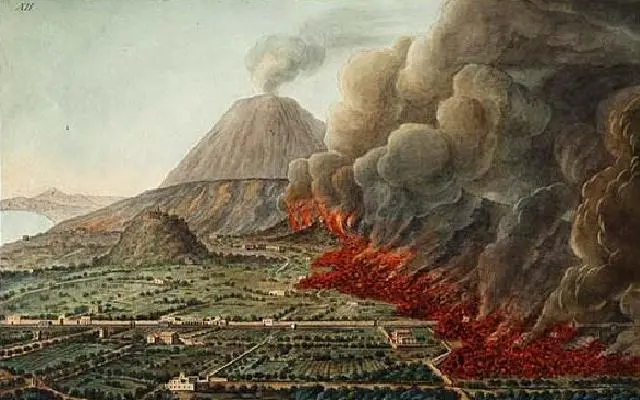
After the eruption of 1631, Vesuvius entered a long phase of activity that continued until 1944. Meanwhile, the excavations of Herculaneum in 1738 and Pompeii in 1748 revealed entire Roman cities buried beneath volcanic debris, confronting observers with the dramatic coexistence of destruction and preservation.
Around the same period, the discovery of the Temple of Serapis (1750) in the nearby Phlegraean Fields provided visible evidence that the Earth itself changed over time. Its columns, marked by traces of marine organisms, suggested that the land had once sunk below sea level before rising again. For many natural philosophers, the site became proof that geological processes unfolded across timescales far exceeding human history.
The region quickly became an essential stop on the Grand Tour (the traditional rite-of-passage trip undertaken by the wealthy), fostering encounters between disciplines we now often think of as distinct. Poetry, philosophy, geology, and natural science existed side by side, frequently shaping one another in unexpected ways.
Davy on the crater
In 1827, weakened by illness and approaching death, Davy travelled once more through Italy. In the second dialogue of Consolations in Travel, his alter ego ‘Philostratus’ stands on the summit of Vesuvius contemplating two opposing scenes at once: the abyss of the crater behind him and the fertile Bay of Naples below.
The contrast is deeply unsettling. The volcano embodies destruction, instability, and forces beyond human control, while beneath it Naples “appears emulous of nature, for the city below is full of activity”. Davy’s attention is drawn especially to a steamboat departing for Palermo, an image of modern industry crossing an ancient volcanic landscape.
The scene prompts a meditation on time itself. Looking toward Pompeii and Herculaneum, Davy reflects on cities that had “remained for centuries as if [they] had been swept from the face of the earth”, only to reappear centuries later almost uncannily intact. Yet he also recognises a deeper paradox: Herculaneum, buried by volcanic eruptions, had itself been built from materials produced by far older geological processes “beyond the reach of history”.
The ruins, therefore, contain multiple temporal layers at once. Human civilisation appears only briefly within geological time, emerging from the Earth and eventually returning to it. What matters is not only Davy’s geological insight, but the way he arrives at it. Observation merges seamlessly with reverie, memory, and imagination. The volcano becomes both a scientific object and a philosophical instrument for thinking about humanity’s place within nature.
Leopardi and the broom flower
Nearly a decade later, Leopardi approached the same landscape from a different direction. In La ginestra, written near Naples in 1836, Vesuvius becomes the backdrop for one of the most powerful meditations on human fragility in European literature.
The poem centres on the broom flower growing on the barren slopes of the volcano. Unlike humanity, which Leopardi portrays as arrogant in its belief in progress and mastery over nature, the flower survives precisely because it recognises its vulnerability. Fragile yet resilient, it becomes a symbol of dignity in the face of forces it cannot control.
Throughout the poem, Leopardi evokes the buried cities around Vesuvius as reminders of nature’s indifference to human ambition. Civilisations rise, flourish, and disappear, while the volcano remains. In one passage, contemplating the night sky above the volcanic landscape, the poet reflects on the insignificance not only of humanity, but of the Earth itself within the immensity of the cosmos:
and once my eyes have focused on those lights,
which seem a tiny point to them,
though they’re enormous, so that next to these
the earth and sea
are in truth no greater than a speck
to which not only man
but this globe where man is nothing
is totally unknown […]
Science and poetry at the edge of the crater
What links Davy and Leopardi is not only their shared fascination with volcanoes, but a common understanding that knowledge emerges through the interplay of observation and imagination.
Davy stated this explicitly in his 1807 essay Parallels between Arts and Science, where he argued that scientific discovery depends upon the same creative faculties associated with poetry and art: “Imagination, as well as reason is necessary to perfection in the philosophical mind”. Great scientists and great artists alike possess the ability to perceive analogies and connect apparently distant phenomena.
Leopardi arrived at a similar conclusion from a literary perspective. In his intellectual diary, the Zibaldone, he reflects on the colpo d’occhio (coup d’oeil), the sudden intuitive synthesis through which scattered observations are gathered into a meaningful whole. Understanding nature, for Leopardi, requires more than analytical reason alone: it also depends upon imagination, intuition, and the capacity to perceive hidden relationships.
For both writers, insight emerges not through the accumulation of facts alone, but through moments of synthesis in which geology, history, emotion, and imagination suddenly converge. This is what makes Vesuvius so important in both works. The volcano was not merely a scientific object or a poetic symbol, but a place where disciplinary boundaries themselves became porous. At the edge of the crater, geology turned philosophical, poetry became historical, and scientific observation opened onto existential reflection.
Today, we often treat science and literature as separate cultures, governed by different languages and methods. Davy and Leopardi remind us that, in the Romantic period, the boundary between them was far less clear: chemists wrote poetry; poets engaged with geology and astronomy. Both sought to understand humanity’s place within a world newly revealed as ancient, unstable, and profoundly interconnected.
At Vesuvius, science and literature did not simply meet. They became, for a moment, almost indistinguishable.
About the author
Gennaro Ambrosino is a PhD candidate in Italian Studies at the University of Warwick and Freer Fellow at the Ri. His research examines the intersections of literature, science, archaeology, and geology in Italy between the late eighteenth and early nineteenth centuries, with a particular focus on Naples, Vesuvius, and Pompeii.
The Freer Fellowship at the Ri
The Ri Freer Prize Fellowships are writing-up awards for doctoral candidates researching the history of science, history of the Royal Institution, or heritage conservation science. Find out more
Bibliography
- John Brewer, Volcanic: Vesuvius in the Age of Revolutions (Yale University Press, 2023)
- Fabio Camilletti, and Paola Cori (eds.), Ten Steps: Critical Inquiries on Leopardi, ed. by Fabio Camilletti and Paola Cori (Peter Lang, 2015)
- Sabrina Ferri, Ruins Past: Modernity in Italy, 1744-1836 (Voltaire Foundation, 2015)
- Jan Golinski, The Experimental Self: Humphry Davy and the Making of a Man of Science (The University of Chicago Press, 2017)
- Noah Heringman, Romantic Science: The Literary Forms of Natural History (State University of New York Press, 2003)
- Sharon Ruston, ‘Humphry Davy’s Inventions’, Romanticism, 31.1 (2025), pp. 10-21
- Sharon Ruston, Creating Romanticism: Case Studies in the Literature, Science and Medicine of the 1790s (Palgrave, 2013).