
Science-fiction often takes inspiration from real science, and the upcoming film Project Hail Mary is no different. With the hotly-anticipated Hollywood blockbuster – starring Ryan Gosling and directed by the duo behind the ‘Spider-Verse’ – hits cinemas in the UK, microbiologist Josh Horton looks at the science behind the fiction.
Spoilers ahead!
The Plot: A Solar Catastrophe
The story follows Ryland Grace: an astronaut who wakes from a coma with no recollection of himself or his mission. He eventually remembers that he is the sole survivor on a desperate journey to the Tau Ceti solar system. His mission? Searching for a solution to the catastrophic dimming of our Sun, caused by an alien microorganism: Astrophage
Astrophage: The Light-Eater
In the book the film is adapted from – Andy Weir’s 2021 Sci-fi bestseller – a fictional single-celled organisim called astrophage uses the light emitted from the Sun as its food (it “eats” sunlight), reducing the Sun’s output by 10%. This would be enough to trigger a terminal ice age on Earth and destroy life as we know it.
Astrophage are 10 micrometres in diameter, which is approximately the size of an average animal cell. Interestingly, it shares many qualities common to all life on Earth – being primarily made up of water, storing their genetic code using DNA, and using energy in the form of ATP. They even have mitochondria (the so-called ‘powerhouse of the cell’), a trait common to a group of organisms called eukaryotes, which include fungi, animals, and plants (but not bacteria.)

The Sun’s surface approaches temperatures close to 5,500 °C and in Weir’s book, astrophage are believed to survive in this environment. If we were to discover an organism like this in real-life, it would far surpass records for life on Earth: the highest recorded temperature an organism that has been observed to reproduce within was 122 °C by the single-celled organism Methanopyrus kandleri – it was discovered on the wall of a hydrothermal vent at the bottom of the Gulf of California.

Astrophage convert any excess electromagnetic energy above 96.415 °C (the cell’s core temperature) to mass – and convert this mass back to infra-red light if it drops below its core temperature, or to move using the light for propulsion. Whilst we haven’t seen an organism on Earth be able to use the entire electromagnetic spectrum emitted by the Sun for energy, we have seen many organisms that use certain wavelengths. One obvious example is photosynthesis: in plants, they absorb blue and red light and use this energy to convert carbon dioxide and water to energy in the form of glucose sugar. Some microorganisms that are found in environments with vastly reduced light compared to plants (e.g. at the bottom of the ocean or lakes), such as ‘green sulfur bacteria’, ‘purple bacteria’ and ‘heliobacteria’ can absorb light all the way into the infrared light, in their version of photosynthesis.
However, this is nowhere near all the light from the electromagnetic spectrum. Astrophage is described as absorbing all types of light, including ultraviolet light, and even gamma radiation – the type of radiation that is used in medicine for killing cancer cells, is released from nuclear reactors, and is present to such high levels in outer space it can be a health hazard for astronauts. This therefore led to the use of astrophage as a radiation shield for the astronauts in the film, to protect them from the damaging effects of radiation. And this may not be as far-fetched as it seems.
Types of fungi similar to black mould were discovered in the Chernobyl Exclusion Zone and Nuclear Power Plant, where there are radiation levels 3-5 times above typical background levels on Earth. These fungi grow towards a source of radiation – a process called ‘radiotropism’ – and many appear to grow better under radiation. This finding has led to the theory that the fungi may absorb gamma radiation and convert it into energy – like in photosynthesis but with radiation, called ‘radiosynthesis’. Scientists have therefore taken this fungus to the International Space Station to further investigate its potential for use as a radiation shield; early research has shown that it effectively acts as a radiation shield for certain types of radiation. But unfortunately, it is not as wide ranging as astrophage.
So, as one would expect, astrophage would be unlike anything we have ever seen on Earth in one organism. But there are some aspects of astrophage that multiple organisms together could achieve.
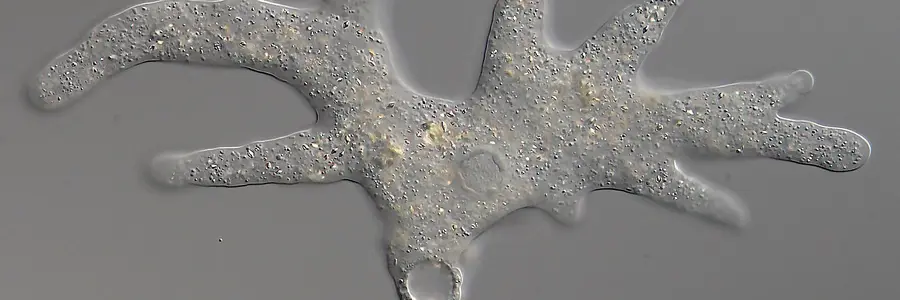
Taumoeba – astrophage’s predator
Having arrived at the Tau Ceti solar system, Ryland Grace discovers a whole host of microbial life, including a predator of astrophage that engulfs the cell, which Grace calls taumoeba. Grace takes inspiration from amoeba when naming taumoeba due to its appearance and the way in which it engulfs and feeds on astrophage. Amoebae have a distinctive shape with ‘pseudopods’ – arm-like extensions. Amoebae, and seemingly taumoeba, eat their food by a process called phagocytosis, which Grace describes in the book – extending the cell’s pseudopods to encircle and eventually engulf their (often still very alive) food. Thus Grace believes he has found the solution to astrophage’s consumption of the Sun’s light.
But the unfortunate issue with taumoeba, that stopped Grace’s celebrations in their tracks, is the fact that taumoeba cannot tolerate the nitrogen concentrations found on Venus – where astrophage spent a lot of its time. This is very confusing for Grace, as nitrogen is abundant on Earth (approximately 78% of air on Earth is nitrogen), and is essential for the building blocks of life, such as DNA and proteins. Therefore it is extremely unlikely that a similar trait would be found on Earth, suggesting that taumoeba may not conform to the typical rules of life that we see on Earth.
Explore the Search for Real Alien Life
While astrophage and taumoeba would push the boundaries of known science, their biological foundations remain remarkably grounded. The real-world parallels, from the heat-loving organism that grows at 122 °C, to the radiation-eating fungi of Chernobyl, are testament to the vast and varied nature of life on Earth. And as scientists look to the skies for life beyond our planet, and with the most likely outcome being the discovery of microbial life, perhaps there may be more similarities to Earth life than we first thought.
To discover more about the real search for life beyond Earth, watch the 2025 Christmas Lectures, supported by CGI. Across three Lectures, space scientist Dame Dr Maggie Aderin takes us on a voyage deep into space, on an astronomical search for extraterrestrial life, celebrating 200 years of the lecture series.