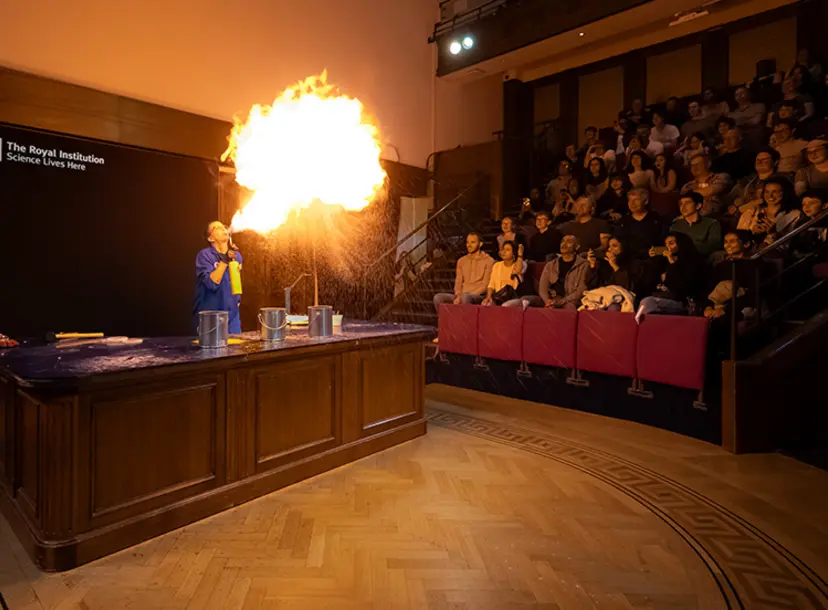
The Lecture Theatre in the Royal Institution, at 21 Albemarle Street in the heart of London’s Mayfair district, is one of the world’s iconic academic theatres. And as a space that’s over 225 years old, it’s had a colourful history!
To mark the final week of the Ri’s Discover200 celebration of the 200th anniversary of two Ri Theatre staples – the Friday Evening Discourse and the annual Christmas Lectures® – we take a look back over the timeline of one of London’s great spaces.
The Ri purchased 21 Albemarle Street – at the time made up of 3 separate houses – in 1799, and appointed a young Thomas Webster, who at that point was in his 20s, as Clerk of the Works. Scotsman Webster, who worked as an architect and geologist, set about designing a lecture theatre for the Ri so that public events on the latest scientific progress could be hosted and the Ri could fulfil its purpose as a home of science communication for the ‘common purposes of life’.
He took inspiration from anatomical theatres, which had been invented about 200 years earlier and were characterised by steep seating in a circular or semi-circular arrangement – allowing a large audience to get a close-up look of the stage. Whilst anatomical theatres were intended for dissections or surgeries, Webster may have felt that the Ri’s audience deserved a good view of our now-famous demonstrations!
Webster also deliberately shaped the walls so that the Theatre acts in a similar way to a ‘whispering gallery’ and there is a spot on the stage where the speaker’s voice is reflected; adding excellent acoustics to the excellent view!
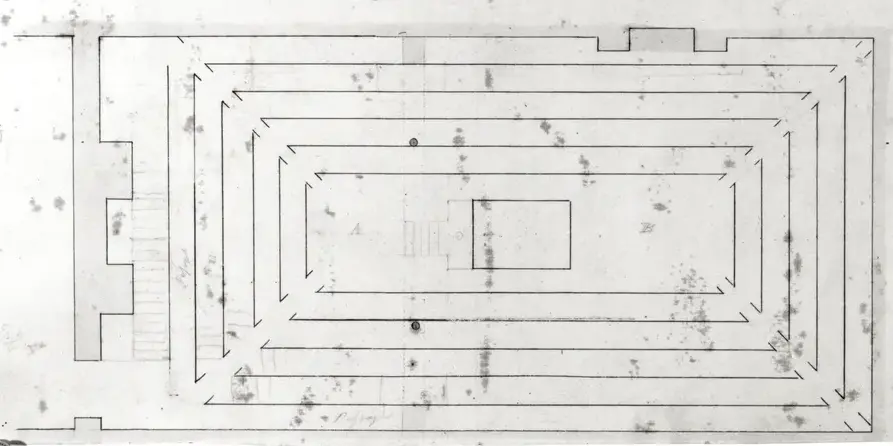
The Ri still holds some of the original sketches and designs for the theatre within in its archive – as well as the plans to use the Library as a public venue while the Theatre was being constructed – and some are on public display in our museum. The overhead plan pictured below, dating from 1800, shows a plan for the Library to be temporarily laid out in a rectangular design, with seating all around a central table. By the time the theatre was completed, later that year, the finalised design was a semi-circle, with the lecturer’s desk in front of a fireplace, and the gallery supported by poles, with the whole theatre able to hold over 1000 people. Another cross-section drawing from 1800 shows how a corridor with stairs would be built under the first tier of seating to provide access, and also shows the proposed cupola that would be built on the roof for ventilation and to provide light into the theatre.
The Theatre became a centre point for the Ri’s public events, and scientific demonstrations. The first lecture was delivered by Thomas Garnett, the Ri’s first Professor of Natural Philosophy and Chemistry. The theatre and the Ri became an immediate public smash hit. Sir Humphry Davy joined the Ri and gave his first series of lectures in the theatre in 1801 gaining significant fame and acclaim. He would go on to use electrolysis to isolate potassium and sodium for the first time in 1807, and announced and demonstrated his discoveries in the theatre. Such was the popularity of Davy’s talks, that Albemarle Street was made London’s first one-way road – to accommodate the volume of traffic; carriages bringing people to and from Davy’s lectures.
1825 saw the advent of the Christmas Lectures®, and Friday Evening Discourses (now known simply as Ri Discourses), both instigated by Michael Faraday. Discourses were originally intended as informal evenings for Ri members, in the Library, to discuss new advancements of the day. However, their popularity soon saw them move to the Theatre, in February 1826, and by the mid-1800s, attending a discourse was seen as a fashionable activity, akin to going to the opera, according to science historian Professor Frank James. Discourses evolved into a space to share the latest scientific discoveries, with Faraday sharing his theory of electromagnetism in 1831, and JJ Thomson announcing the discovery of the electron in 1897; amazingly without ever using the term ‘electron’!
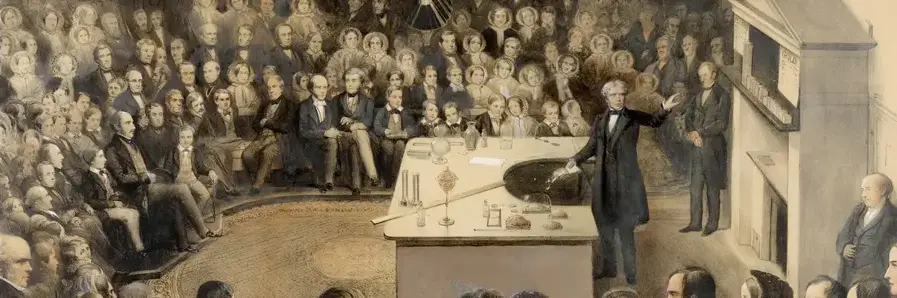
A popular image of the theatre in full use can be seen today at the Ri, showcasing the theatre in 1855 when Michael Faraday presented the Christmas Lectures® on ‘The Distinctive Properties of the Common Metals'. The Victorian era lithograph by Alexander Blaikley of Faraday presenting the first lecture of that series (pictured below) gained fame as it was reproduced in the London Illustrated News. It shows three of the country’s most famous people at the time in attendance – Prince Albert (the Prince Consort), Prince Edward (the Prince of Wales), and Prince Alfred. The image has been reproduced countless times and Blaikley was even asked to reproduce the image as an oil painting for the Royal Society of Chemistry.
Blaikley’s image is often confused with the image of Faraday that featured for many years on the UK’s £20, when that image is actually taken from a bronze plaque showing Faraday lecturing at the London Institute, and is displayed in the Ante Room of the Ri.
The Theatre stood relatively unaltered for nearly 130 years. But on 29 December 1927, the electrical substation in the basement exploded, just two hours after a Christmas Lecture had finished. While no one was injured and the theatre was not damaged, the managers of the Ri realised that the theatre needed to be improved, particularly with the addition of fire exits. Hence the decision was taken to demolish and rebuild the theatre into a second iteration.
The second theatre was built to the same size, specification, and shape, as it was deemed to be an excellent original design, and retained some original features such as the 1871 wallpaper, which further enhances the acoustic performance of the Theatre provided by the domed ceiling. The gallery was rebuilt as a cantilevered design, dispensing with the support poles, with the entrances established at floor-level, removing the short stairs from the ambulatory through the vons. The steep seating rake was retained, but the padded benches were swapped for individual seats in the main stalls (the gallery still retains the bench seating), which reduced the capacity of the Theatre to a little over 400, which remains to this day.
The Ri escaped any significant bomb damage in World War II, and the theatre remained unchanged. The Theatre then started making its regular TV appearance from 1966, when the Christmas Lectures® began regular televised broadcasting on the BBC as whole series. To assist with this the Ri added a small camera/projector booth and editing desk at the back of the theatre opposite the stage. Television brought a whole new audience, and wave of popularity, to the Ri, with its Theatre at the heart. Many who watched the lectures growing up in the 1970s, 80s, and 90s may remember the distinctive plush blue seats that held many an enraptured audience.
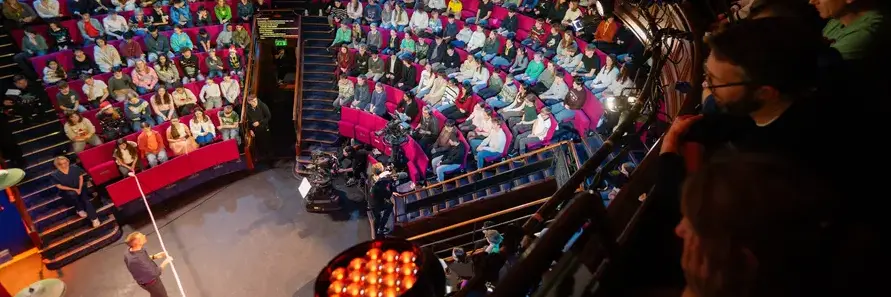
The Theatre’s latest renovation occurred in the early 21st Century, and was completed in 2008. The works, which were undertaken by the firm of British architect Sir Terry Farrell, saw the Theatre modernised, with the seats reupholstered to their now signature magenta fabric, and the projection booth (which was in the centre of the upper rows of the main stalls) removed entirely, and replaced with modern projectors hung from the gallery.
Now, as we complete our year of Discover200 celebrations, the theatre is still going strong, having seen over 25,000 public science talks delivered across its iterations. We hope that you find the time to visit this famous space, and experience its intimate atmosphere.
Looking to the future
Time doesn't stop, and neither does the evolution of our Theatre. In 2026, thanks to a generous grant from the Wolfson Foundation, the Ri Theatre will undergo major renovations, which will include a state-of-the-art audio-visual system for online/in-person hybrid events, accessibility improvements, and restoration of the iconic lecture desk.