The year after the Christmas Lectures and the Friday Evening Discourses were established at the Royal Institution, London University was founded in 1826, though the first students were not admitted until October 1828. Ten years later, in 1836, it was chartered as University College London and the same year with King’s College, London (chartered 1829) it became part of the new federal University of London. University College London is thus celebrating its bicentenary this year.
What distinguished UCL from the other two English universities at the time was that there were no religious tests required for either staff or students. Until well into the nineteenth century students at both Oxford and Cambridge Universities had to subscribe to the thirty-nine articles of the Church of England in order to take a degree. Such lack of tests earned UCL the somewhat unwarranted sobriquet of the Godless institution of Gower Street. Unfair because the founders were a mixture of dissenters (including Quakers) as well as Jews and those with no obvious religious beliefs. To this day, UCL does not have a theological or divinity faculty.
With UCL and the Royal Institution being geographically close to each other – less than a thirty-minute walk – and with UCL having a strong scientific presence, it might perhaps be expected that close links between them would be developed over the last two centuries, especially in science. But this was not an exclusive relationship as the Royal Institution also had close links to the Anglican institutions of King’s College, London (Charles Wheatstone, John Frederic Daniell), Cambridge University (William Whewell, George Stokes) and Oxford University (William Buckland), though all of these came about through the scientific network of Michael Faraday who dominated the Royal Institution during the middle third of the nineteenth century.
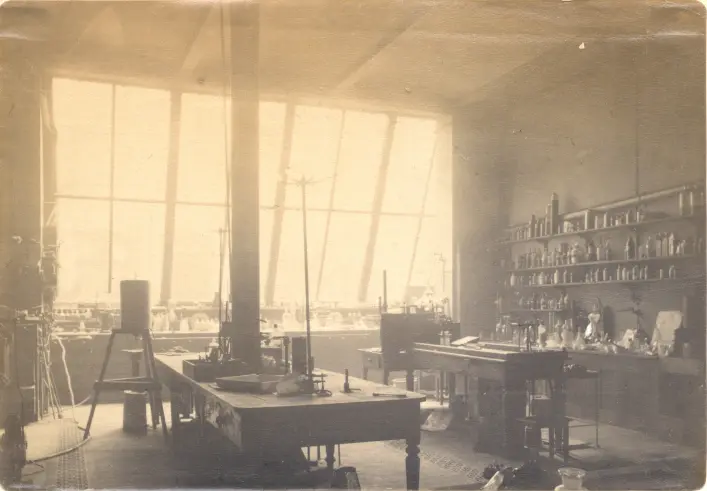
In October 1827 the newly appointed Professor of Natural Philosophy and Astronomy, Dionysius Lardner, wrote on behalf of the College to Faraday inviting him to become the first Professor of Chemistry there. This was not an invitation that either Oxford or Cambridge could have extended to him as it was well-known that Faraday was a Sandemanian, a dissenting sect established as a direct result of the opposition to state involvement in the church in both England and Scotland; he only stepped foot once inside an Anglican Church (that was to get married as required by law in 1821). Faraday, who had not yet reached the levels of fame that he would achieve during the next couple of decades, politely declined UCL’s offer citing his primary commitment to the Royal Institution as the main reason. Instead, the College appointed the Jamaican born, Edinburgh and Göttingen educated, chemist Edward Turner. Thereafter Faraday did not have much to do with UCL, though it is possible that he visited to see John Elliotson’s mesmeric experiments at University College Hospital. He did however, accept, along with his Royal Institution colleague William Thomas Brande, membership of the original Senate of the University of London formed in 1836.
The only joint appointment between UCL and the Royal Institution during the nineteenth century was William Ritchie who served as Professor of Natural Philosophy at both institutions for most of the 1830s. However, where there were other continuing and long-term links between the organisations found in those UCL Professors who delivered Friday Evening Discourses, the Christmas Lectures and who held the Fullerian Professorship of Physiology and Comparative Anatomy.
Friday Evening Discourses, which began towards the end of 1825, were one of Faraday’s ideas and were originally informal events for Royal Institution Members only. Because of their popularity, the Discourses in the following years led to a significant increase in its membership which helped it out of a financial crisis. By the early 1850s Discourses had become very formal affairs indeed and were occasionally attended by members of the Royal Family especially Prince Albert who formed a strong rapport with Faraday. Those from UCL who delivered Discourses during Faraday’s time included Edward Turner, Dionysius Lardner, the Professor of Comparative Anatomy, Robert Edmond Grant, the Professor of English Language and Literature, Robert Latham, and the Professor of Forensic Medicine, Benjamin Carpenter.
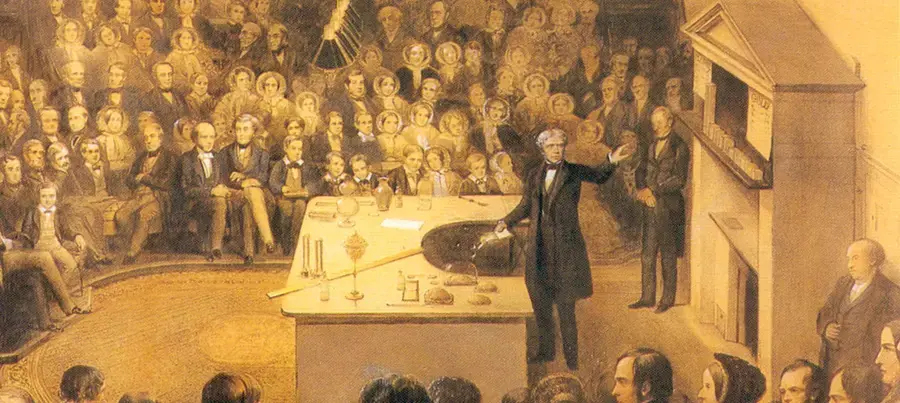
The origin of the Christmas Lectures, which also began towards the end of 1825, is more opaque than the Discourses. They seem to have evolved out of the lecture series that had been delivered since the founding of the Royal Institution in 1799. Faraday’s role is not clear, but he delivered the third series and would go on to give a further eighteen. Professors from UCL who delivered the series were few and far between, especially in the nineteenth century. The first was the botanist John Lindley in 1833-4, whilst the second was the Professor of Electrical Technology, John Ambrose Fleming sixty years later in 1894-5. Fleming gave three more series during the early twentieth century, while the Nobel Prize winning physiologist and Foulerton Research Professor A.V. Hill gave a series while the Quain Professor of Physics E.N. da C. (Percy) Andrade delivered three.
In the early 1830s John Fuller, whose income came from his Jamaican plantations and who as an MP had strenuously opposed the abolition of the trade in enslaved people, endowed two chairs at the Royal Institution. The first was the Fullerian Professorship of Chemistry, held by Faraday until his death in 1867 and which thereafter tended to be held by the most senior figure in the Royal Institution, denominated Superintendent of the House. The second chair was the Fullerian Professorship of Physiology and Comparative Anatomy which most of the occupants held for three-year terms. Professors from UCL who simultaneously held this chair during the nineteenth and into the twentieth century included Carpenter and Grant as well as Michael Foster, J.B.S. Haldane and J.Z. Young among others.
After Faraday, the Royal Institution was led by John Tyndall and then James Dewar, neither of whom had connections with UCL, though Dewar engaged in a heated controversy over the identification of various gaseous elements with UCL’s Professor of Chemistry, William Ramsay. During Dewar’s term of office, the Davy Faraday Research Laboratory (DFRL), funded by the industrial chemist Ludwig Mond, was founded at the Ri. This laboratory sought to establish a new way of conducting scientific research and it was here that Dewer undertook his work on liquefying gases including hydrogen. Dewar died in office in 1923 after forty-six years of leading the Royal Institution. By then due to his lack of leadership and in the aftermath of the Great War, the Royal Institution had become somewhat moribund in both its research and lecturing activities. To revivify the Institution the Quain Professor of Physics at UCL, William Henry Bragg was appointed to lead the Royal Institution. Born in Cumberland, Bragg had taught at the Universities of Adelaide and Leeds before being appointed Quain Professor in 1915, though he spent most of the Great War working on anti-submarine warfare. The same year as his appointment he with his son jointly won the 1915 Physics Nobel Prize for their work in X-ray crystallography.
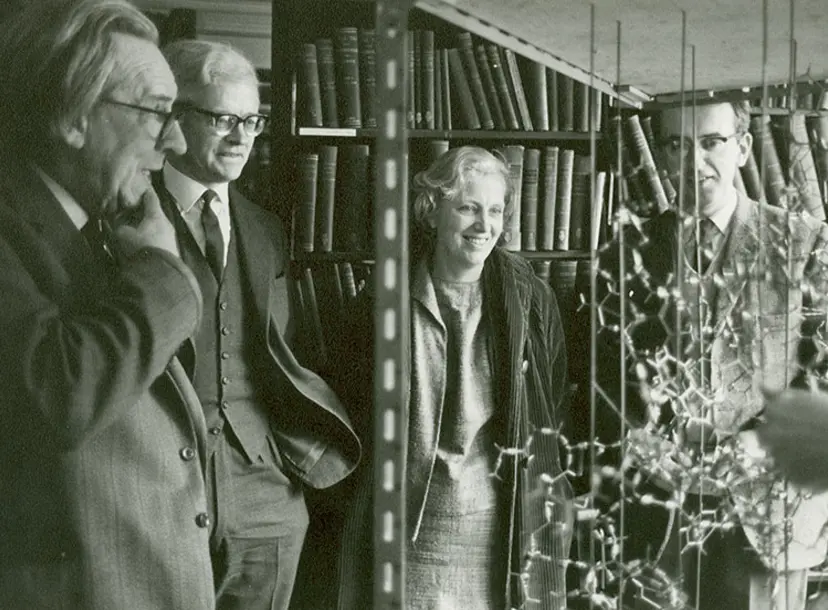
Bragg did indeed turn the Royal Institution around creating a major research group in X-ray crystallography, revivifying the Institution’s lecture programme and taking advantage of new media technologies, such as film and wireless, to communicate science to a wide audience. One of his researchers who he brought with him from UCL to the Royal Institution was Kathleen Yardley, later Lonsdale. In the late 1920s while working at the University of Leeds, she confirmed using X-ray crystallography, the hexagonal structure of benzene which Faraday had discovered also precisely two centuries ago. She returned to the Royal Institution in the early 1930s. Following Bragg’s death in 1942 Lonsdale effectively took over direction of research at the Royal Institution for four years. (Henry Dale, who was Bragg’s successor, did not, owing to his scientific work for the War Cabinet, have time to oversee research). In 1946 Lonsdale, one of the first two women to be elected a Fellow of the Royal Society of London, returned to UCL as Reader in Crystallography, promoted three years later to Professor – the UCL-RI relationship was not just one way.
Dale was only ever intended as an interim head of the Royal Institution for the duration of the war and he too stepped down in 1946. There was discussion of replacing him with A.V. Hill. His UCL laboratory there had been blitzed and he wanted to establish a biophysics research group at the Royal Institution. However, concern was expressed in the Royal Institution about the possibility of this work involving animal experimentation. The plan was dropped and instead the colloid chemist Eric Rideal was appointed. That appointment was not especially successful and in 1949 he moved to King’s College, London.
If that appointment was not successful, the next was to be a complete disaster. On paper the Quain Professor at UCL Percy Andrade looked the ideal person to lead the Royal Institution during the 1950s. He was a highly respected scientist, had published a number of beautifully written popular science books, had a strong and informed interest in the history of science and was also a collector of rare scientific books. But he had an implacable modernising agenda for the Royal Institution, combined with a well-documented temper and a just a touch of paranoia. (Each New Year’s Day he would complain to the Beadles at UCL that once again his name had not appeared on the Honours list!). He lasted just over two years until he was dismissed from his post, subsequently successfully suing the Royal Institution for wrongful dismissal and receiving £7000 – a large sum in the 1950s. He was replaced by Lawrence Bragg (William Bragg’s son) who had been Director of the Cavendish Laboratory, Cambridge. During the 1950s and the first half of the 1960s, he slowly and diplomatically modernised the Royal Institution making it, once again, a leading centre for X-ray crystallography, but formed no strong connection with UCL (although students, such as Louise Johnson, received their doctorates from the University of London).
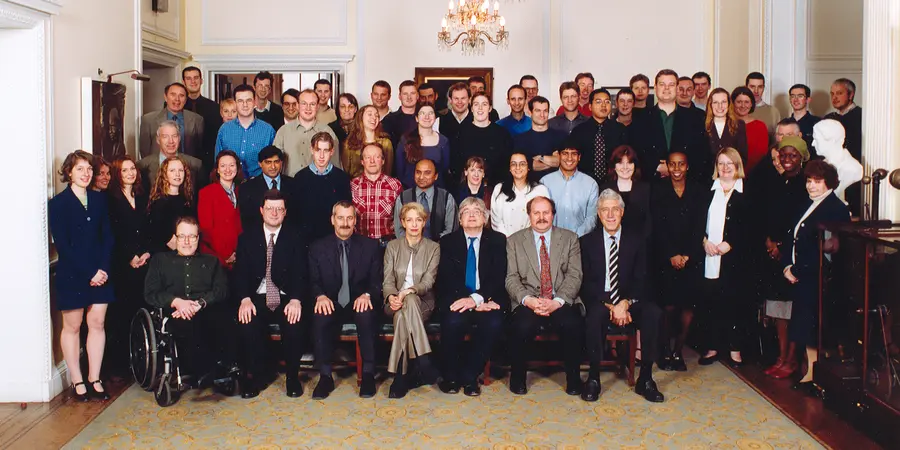
After George Porter became Director in 1966, the Royal Institution’s main university partner was Imperial College. The Davy Faraday Laboratory was strengthened by a growing number of PhD student researchers who needed a university affiliation and the majority were registered with Imperial. Strong links with Imperial continued after Porter left the Ri in 1985 to become President of the Royal Society, especially with the research group of the then Wolfson Professor, David Phillips (appointed 1980) who left in 1989 to join Imperial Chemistry. Richard Catlow, now chair of the Ri Trustees, was recruited to the Wolfson Chair and in 1991, Peter Day replaced John Meurig Thomas as Director of the Royal Institution and the DFRL. Both Catlow and Day had strong links with UCL and the relationship began to grow with PhD researchers increasingly registered with UCL Chemistry. The theme of the DFRL in materials and catalytic chemistry also resonated well with research priorities in UCL Chemistry
By the 1990s it became clear that both the Royal Institution and UCL would benefit from a more formal relationship. Between 1993 and 1995 Day and Catlow fostered close connections between the two organisations which resulted in the signing of an MoU establishing such a link, whereby the DFRL Professorial staff became joint RI-UCL appointments. The arrangements helped the Royal Institution by giving the DFRL access to additional funding opportunities available to university institutions, while UCL benefitted by including Royal Institution staff and publications in research evaluation processes, especially the Research Assessment Exercise (RAE); and indeed in 2021, the UCL Chemistry/DFRL submission to the RAE gained the highest 5* grade. The DFRL further benefitted from being able to bid to the Higher Education Funding Council for funds to provide a much-needed refurbishment of the laboratories. And the relationship deepened more generally, with PhD researchers often dividing their time between the Royal Institution and UCL and with several DFRL staff being recruited as academic staff in UCL. Importantly, the relationship was reciprocal with UCL staff also spending time at the Royal Institution and in some cases contributing to the Schools and public programmes
In 2002, Catlow was appointed Head of UCL Chemistry – a post which he held jointly with that of Director of the DFRL, where his research was still based. In 2006 the Royal Institution refurbishment necessitated that its research programme relocate and suitable accommodation was found in UCL, in the Kathleen Lonsdale Building. The programme of the team had evolved and was now more suited to the environment at UCL where it remained after the completion of the Ri refurbishment.
The Ri-UCL relationship, however, continued and in 2008, a team led by Quentin Pankhurst and Thanh Nguyen moved from UCL to the Royal Institution. The relationship was different with the team being UCL staff and students to whom the laboratory space was leased, but the relationship remained deeper than that of landlord and tenant. The research programme now in the link between nano-science and biomedicine remains a key component of the Royal Institution. It has led to several successful spin -off companies and continues to thrive, which illustrate the benefits of two institutions collaborating over two centuries.
About the authors
Frank James is Professor of History of Science at UCL.
Sir Richard Catlow is Professor of Chemistry at UCL and Chair of Trustees at the Royal Institution. UCL has recently released a profile on him as part of its Faces of UCL series.