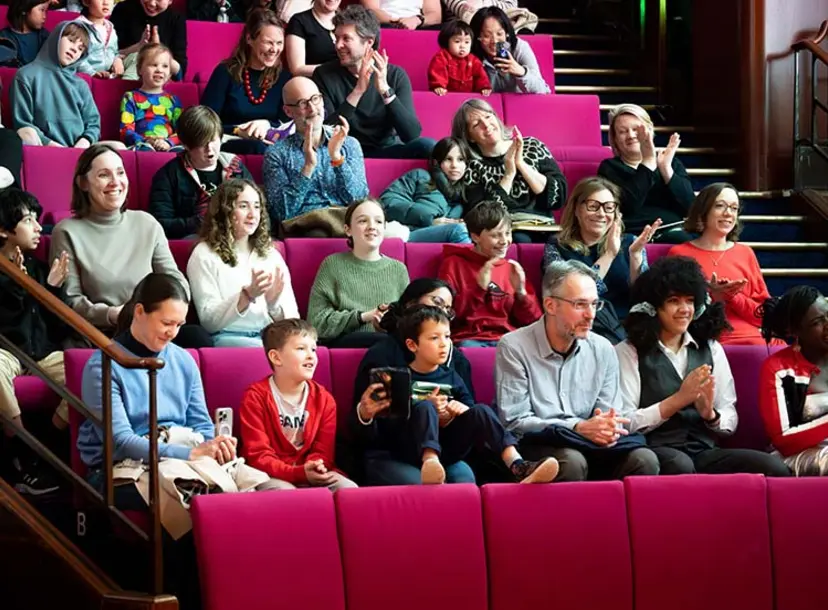
Walking into the Royal Institution on my first day as a member of staff was nerve-wracking. I had visited many times as an attendee, but standing there as staff felt entirely different. I was not about to make great scientific discoveries, my role was bringing people together, helping organise lectures and workshops, but I was about to walk the same corridors as Faraday, Lonsdale, Bragg and Dewar. To continue the legacy of science communication. Looking around the Grand Entrance, the Roundel Room, the Theatre, I felt something shift. For the first time in my life, I had the distinct feeling that I had found my Mothership.
I am autistic, and I think I have found my tribe.
The struggle before
You might think that as a science teacher, surrounded by fellow educators in a setting that champions inclusion, I would have been “seen and heard” and sharing my passion for science with young people every day would have been appreciated. The passion was always there on my part. The difficulty lay in everything around it.
My mind works like a set of interlocking cogs, constantly turning and fitting ideas into a vast web of connections spanning science, history, geography, and culture, so that everything makes sense to me. That interconnectedness is precisely what thrills me about science. Unfortunately, it took me years to realise that some of my colleagues didn’t think this way. I loved challenging my classes with the strange and wonderful: how Tasmanian Devils carry a form of contagious cancer, and then watching for the bright spark who would lean forward and ask, if these mammals can get a contagious cancer, could humans? Or: who is going to ask how a neutron transforms into a proton during radioactive decay? So I can send them on a mission to find something out about Up and Down quarks and get amazed by the particle zoo.
When a young person asked that kind of question, that was so fulfilling. To stimulate students to pull on the thread, that was, for me, what teaching was for.
The sensory environment of a school was deeply exhausting, especially for an autistic woman. The tight time pressures, the sheer volume of bodies moving through corridors, the slaloming between students in the playground just to reach the staffroom. I am very sensitive to smells, high and low pitch noise and movement around me, and it could leave me nauseous and disoriented. Every evening, I felt like I had been put through the spin cycle of a washing machine. I would come home feeling utterly frustrated and utterly drained.
It was simply the wrong environment for the way my brain works. I didn't know that then. I do now.
What autism actually feels like for me
I remember being four years old in preschool and already feeling different. I didn't quite understand the other children, I wanted to read and learn; they, did not share that particular urgency. But I was a happy child as I was in my own world.
I was also in my own world at secondary school, but it was much harder, socially rather than academically. I occasionally experienced what would now be called bullying, from both some teachers and other students, though at the time I simply assumed it was my fault and that I should try harder. I couldn’t understand how others seemed so laid-back and instinctively understood one another, while I was always trying to work out what it was all about. They cared about who liked whom and talked about things I couldn’t relate to; I cared about classical music, books, chess, and learning as much as I could. I hated parties, which seemed to be where friendships were formed.
In boarding school where I was sent to “develop social skills”, I became a mimic, and a bit of a clown, entertainer. I did not analyse it to understand it at the time, but it made me more palatable to my fellow boarders in dorms. I quite liked boarding school as there was a routine and it was safe, it was like a home. But the moment I was old enough to have Wednesday afternoon freedom in the town centre, my instincts drove me to museums, bookshops, cinema and parks. My friends headed straight for cafes to meet other students. We were fond of each other, but we were operating on entirely different frequencies.
That feeling never quite left me. Whether as a student or a member of staff, wherever I worked, I moved through the world feeling faintly like a tourist, always observing, rarely quite belonging even in my own family who are tired of hearing me going on about science. The Brits say square peg in a round hole; the French put it better: I always felt like a hair fallen in the soup.
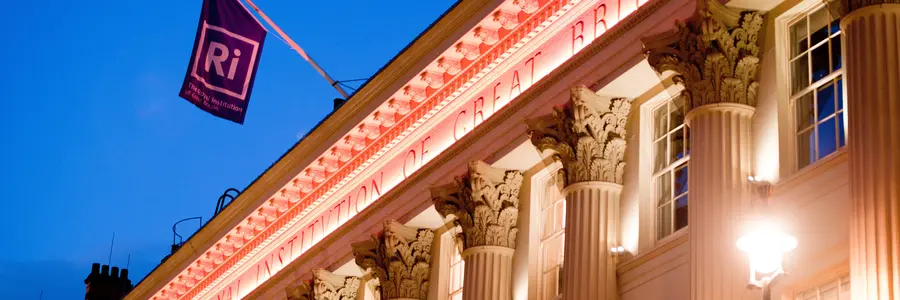
Working at the Ri
Working alongside colleagues, some of whom are also neurodivergent, and many of whom are scientists, has been something else entirely. Here, everyone is passionate about science and passionate about communicating it to each other and to others.
Here, even if you are not completely understood, as no two neurodivergent people are the same, each of us carrying our own particular set of traits, you are seen, you are heard, and you are given patience, positivity and support. It sounds simple, but it was so new to me that it took a full year and a half to sink in. To stop feeling like I would be found out, like I was somewhere I shouldn't be and was about to be asked to leave. To dare, just a little, to feel at home.
Small things have made an enormous difference. I loooove tables. With one glance, I can see everything at once, all the information, all the relationships between things, laid out clearly. Tables just make sense to my brain and… they taste good (yes, I may have a bit of synaesthesia to boot). Some of my colleagues put information I needed into tables for me. That meant more than they probably realise. It’s just one of many examples of the support you get at the Ri.
In previous jobs, when I asked for clarification, I would simply be told the same thing again, in the same way, as if repetition alone might do the trick. On one occasion a colleague told me outright that I needed to LISTEN, that they had shown me once and weren't going to do my job for me. Here, I have learned to say: this is how my brain works best, could you explain it this way? And people do. Even when they are very busy.
I am still learning about what works best, which parts of the way I think are particular to me. You don't question your own mind when it's the only one you've ever inhabited. I simply assumed for example that everyone thought in vivid images, until a student stated, that she cannot visualise anything at all.
I am acutely sensitive to the moods of those around me, I will absorb and reverberate the tension or irritation in a room just as readily as I will its warmth and calm, often before anyone has said a word. So, working with people who the majority of the time have a smile on their faces, makes a world of difference to how the day is going to unfold, and for the first time in my life, I go home cheerful.
Whether they like me or merely tolerate me, I genuinely cannot always tell, that particular social radar has never been my strong suit! But they are kind, they are patient, and right now, that is everything.
The most wonderful thing at the Ri for me is welcoming autistic children to our Holiday Workshops, watching them experience the joy of STEM, and discover others like them. Finding their tribe. Just as I, eventually, found mine.