The chances of anything coming from Mars are a million to one….
Jeff Wayne's lyrics from The War of the Worlds probably weren't based on hard science, but they show how the perceived probability of finding life elsewhere in the solar system has fluctuated significantly over the past century.
Before the space age, we knew so little about planets like Mars that it was quite reasonable to consider that life might be present there, and many science fiction stories speculated on possible encounters with Martian life-forms.
However, when we started sending spacecraft to investigate Mars in more detail, it rapidly became apparent that it was entirely inhospitable for sophisticated multicellular creatures like us. In particular, Mars is an arid, dusty place, and doesn't have oceans of liquid water on its surface today (although probes sent to the planet have proved conclusively that water was abundant there in the past).
Belief in Martians waned significantly, as it was concluded that the planet orbited the Sun outside of the “habitable zone”.
But then, as our scientific understanding improved, the probability pendulum started to swing back again.
We examined some of the oldest rocks on Earth, and even there we found chemical signatures of past life, implying that almost as soon as our planet had cooled down to the point where liquid water could exist as oceans on the surface, life was present.
We have also found vast quantities of impressively robust bacteria living in the rocks below our feet here on Earth. They make a living via chemosynthesis in pressure and temperature conditions that could reasonably be assumed to exist somewhere beneath the surface of Mars today. Persistent oceans no longer seem to be the essential prerequisite for life that they once were.
Not unreasonably, it was assumed that Earth’s early life resulted from a transition between inorganic and organic processes here on our home planet. But as we have learned more about the history of the solar system, another more intriguing possibility has become apparent.
Mars is a smaller planet than Earth, and orbits further from the Sun. For both these reasons, it seems reasonable to assume that it cooled down and acquired oceans of liquid water well before the Earth.
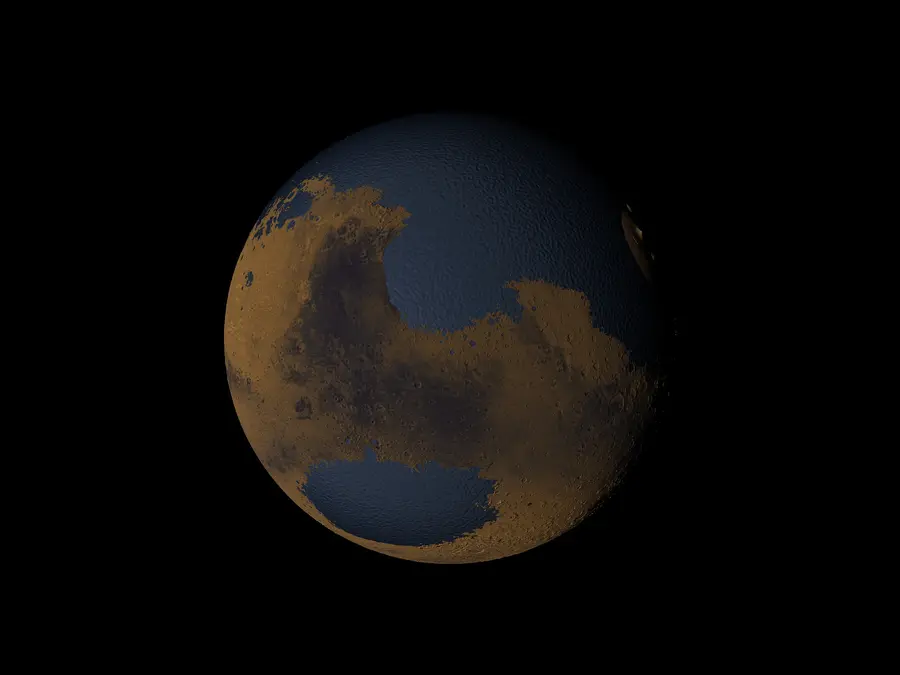
Supposing that simple bacterial life got started in those oceans, is it then possible that some of those microbes made their way to the early Earth?
We know for certain that major asteroid impacts took place on Mars, some of which could have propelled rocks from Mars towards the inner solar system.

We also have strong physical evidence this transfer process really takes place. Meteorite finds on Earth (including Nahkla and Allan Hills 84001) have been matched chemically to Mars.
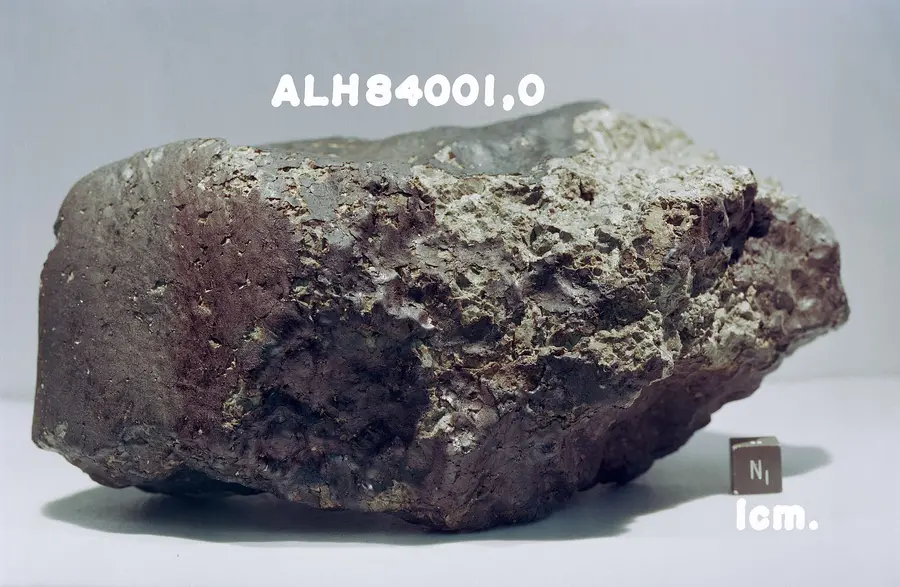
Might some early Martian bacteria have hitched a ride inside such a meteorite, and then have proliferated once they arrived on Earth?
Did they evolve into us, and so might we all actually be Martians?
Even if you consider this scenario implausible, it is also worth considering the inverse process. We know that, like Mars, the Earth has been bombarded from space over the millennia, and although (since the Earth is a larger planet with a higher escape velocity than Mars), the chances of material moving in the other direction are lower, it remains feasible following major impacts.
Due to its very thin atmosphere, the surface of Mars today is subjected to high doses of radiation. But in the distant past, any pioneering Earth bacteria arriving on Mars might have found conditions rather more to their liking, and (as has happened on Earth), might then have moved underground.
We are still seeking to understand some of the puzzling observations that have been made on Mars (sudden, seasonal bursts of methane gas in its atmosphere, which disappear as rapidly as they appear); but one possible source for this gas is a population of microbes living below the surface of the planet.
Hence, if we ever discover tiny life-forms living underground on Mars, we might also find that they’re our very distant cousins.
Christmas is going to be out-of-this-world!
The 2025 Christmas Lectures, supported by CGI, will take us on a journey through our Solar System and beyond.
For the momentous 200th anniversary of the series, join space scientist Maggie Aderin for a stellar voyage of discovery, from the origins of our Universe to the latest evidence for life on distant planets.
Tune in to BBC Four and iPlayer 28, 29 and 30 December at 7.00pm
About the author
Dr Stuart Eves is a Fellow of the Royal Astronomical Society, a space industry consultant, and a Royal Institution lecturer.
He has taken a keen interest as our understanding of the space realm has increased immensely during his lifetime, but he is particularly intrigued by the aspects of the universe that we still don't understand.